Thursday, October 8, 2015
MY ARTISTICAL TEMPERATURE
Popeye is a sculptor, and Bluto paints in this wonderful 1937 cartoon from the Fleischer Studios.

Wednesday, October 7, 2015
BOB DYLAN COMMERCIALS
This commerical blindsided me last night during a football game. Apparently, a computer was pitted against a human being, albeit an extraordinary one. (Full disclosure: I'm a Dylan fan, but not enamored with IBM.) Without opening a can of worms regarding Bob "selling out," or the nasty history of IBM, or how many times you've seen Dylan in concert, or which smart phone you use, or football concussions, I present the commercial in its entirety for your amusement. I used to care, but things have changed. Here's another Dylan commercial that played during the Super Bowl last year.
Saturday, October 3, 2015
THE SAME OLD STORY
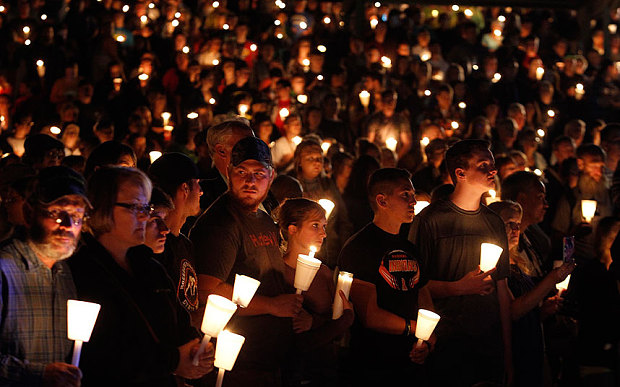
If ISIS killers showed up in Roseburg, Oregon, and executed students with impunity, maybe America would treat mass killing differently, but for now most middle Americans seem more afraid of losing their guns than losing their children. Gun apologists and lobbyists tell us to pray for the victims, but insist the solution to gun violence is more guns. More guns was the solution for the lone gunman who walked into Umpqua Community College and sprayed bullets through classrooms, killing nine and wounding twenty; he had amassed an arsenal of 13 guns.
You've heard it all before. It's the same old story, yet nothing has been done about it. Since the Sandy Hook shootings, there have been at least 986 mass shootings, with shooters killing at least 1,234 people and wounding 3,565 more. How long does it have to go on before people realize we're being held hostage by the gun lobby and gun nuts who misinterpret the U.S. Constitution? Why is it harder to get a driver's license than a high-powered rifle?
Roseburg is a small town in the state of Oregon, my home state, where plenty of people own guns for hunting. Many hunters fear the "Big Guv'mint" is going to take away their beloved guns, so they oppose any meaningful legislation that might stop future student massacres. Even the smalltown sheriff handling the case, John Hanlin, didn't understand the situation until now. According to news reports, he was one of hundreds of sheriffs around the country to vow to stand against any new gun control legislation. He even wrote a letter to the Vice President to that effect, insisting that, "Gun control is NOT the answer to preventing heinous crimes like school shootings."
So what is? The answer isn't more guns, or making it easier with any halfwit with an axe to grind to buy lethal weapons. This has reached a critical point of madness, where something must be done to make sure the nameless zeroes fuming in solitude don't get a chance to treat the rest of us like some video game fantasy.
Do we have to wait for the dumbest among us to catch up with reality, slow learners like Sheriff Hanlin, before we can enact some meaningful gun control laws? I hope not, because there are plenty of dumb people out there who believe whatever they're told by FOX News and the gun lobby. They may never come around. Without realizing it, they believe the rights of this lone gunman are more important than the rights of children, students, and families trying to live in peace, without the risk of being shot by some madman on a death trip who bought his gun easily at a gun show.
Come on, people. Get smart. Let's make it a little tougher for the bad guys.
A quote from one of my favorite books, Catch-22, comes to mind:
"The enemy," resorted Yossarian with weighted precision, "is anybody who's going to get you killed, no matter which side he's on." - Joseph Heller
Wednesday, September 30, 2015
TRANSISTOR TUNES OF SUMMERS PAST
Summer is gone and autumn is here, a time for whiskey and football and whiskey and casting our memories backward over the years and more whiskey as we approach the holidays. Long before iPods and Spotify, we listened to tiny little transistor radios, plastic junky things with tinny speakers, and we were lucky if there was one decent station in town that played music for kids--and by that I mean rock and soul and anything vaguely cool. While the other stations were playing Vic Damone and Vikki Carr we were tuning in some great music through those tinny little speakers, or even a single earplug--primitive by today's standards, for sure, but the music was good and it's all we had. Here are just a few of the tunes we savored.
The Animals, of course, covering an old blues, "The House of the Rising Sun."
Gladys Knight and the Pips, "I Heard it Through the Grapevine."
The Beatles, "I Saw Her Standing There."
And of course the incredible James Brown and his Fabulous Flames, shown here burning up the stage at the T.A.M.I. Show. Mick was waiting in the wings, learning some new steps.
The Animals, of course, covering an old blues, "The House of the Rising Sun."
Gladys Knight and the Pips, "I Heard it Through the Grapevine."
The Beatles, "I Saw Her Standing There."
And of course the incredible James Brown and his Fabulous Flames, shown here burning up the stage at the T.A.M.I. Show. Mick was waiting in the wings, learning some new steps.
Friday, September 13, 2013
AMERICA! THE GREATEST COUNTRY?
Watch out what you ask: You might get an answer you don't like.
(Warning: This contains uncomfortable truths and language most adults are familiar with in a free society.)
Tuesday, September 10, 2013
WALMART FLASH MOB
This will lift your spirits! This flash mob protest in Raleigh, NC, by Walmart workers who have the guts and audacity to believe that they should be treated fairly--and the creativity to something like this off. Some background might be helpful, in case you missed this in a news cycle of twerking and chemical warfare, but this is America at its best. September 5th was a great day as workers and their supporters rallied in 15 cities across the country to demand that Walmart pay higher wages and reinstate the 70 Walmart workers who got fired for striking this summer. Solidarity!.
Friday, July 5, 2013
WHY MAKE ART?

Who needs Art? We're in a recession, right? During tough economic times we've always slashed health care, education, environmental protection, and programs designed to help the hungry and the homeless--critical social services--so why worry about something as ephemeral as "the arts?" Surely, we can jettison a few poems and paintings in favor of more pressing concerns...right? After all, who really needs painting, music, and literature?
The novelist E. L. Doctorow gave this speech before a subcommittee of the House Appropriations Committee in the fall of 1981. It remains a timely statement on the value of art to the human spirit.

For the Artist's Sake
I have always disliked the phrase "the arts." It connotes to me furs and black ties and cocktail receptions, the patronage by the wealthy of work that is tangential to their lives, or that fills them not with dread or awe or visionary joy but with self-satisfaction.
"The arts" have nothing to do with the loneliness of writers or painters working in their rooms year after year, or with actors putting together plays in lofts, or with dancers tearing up their bodies to make spatial descriptions of the hope of beauty or transcendent myth.

So as a working writer I distinguish myself from the arts community. I am confirmed in this when I look at the National Endowment for the Arts' board and program structure. In the past, a very small percentage of the arts budget has been given over to literature, to the grants made to young writers or dramatists or poets of promise. In all the time since its founding, the N.E.A. has found only four writers worthy to sit on its immense board. Instead, the heavy emphasis has been on museums, opera companies, symphony orchestras: just those entities that happen to cater to patrons of "the arts."
I suppose I would have to confess, if asked, that I feel about opera, for instance, that it is not a living art in this country, that we do not naturally write and produce operas from ourselves as a matter of course as, for example, Italy did in the nineteenth century, and that, therefore, as wonderful and exciting as opera production may be, it is essentially the work of conservation of European culture; opera companies are conservators of the past, like museums, and their support by the National Endowment reflects this strong bias or belief in the arts as something from the past rather than the present.

The National Endowment programs I value most are just those likely to be proscribed: first, the programs of individual grants to individual artists in whatever medium — the programs endowing directly the work of living artists; and, second, those programs that do not separate the arts from life, from our own life and times but emphasize the connection — the artists-in-education program, the poets who go into schools, for example, and help children to light the spark in themselves. I cannot imagine anything more responsible than the work persuading a schoolchild to express his or her anguished or joyful observations — and to be self-rewarded with a poem or a painting. Whole lives ride on moments like that.
Or the inter-arts programs, the folk arts, the expansion arts — all bureaucratic terms for encouraging experiment and risk-taking on the part of artists, and for bringing artists in contact with people everywhere in the country, connecting people with the impulses inside themselves. Programs that encourage participation rather than the passive receipt of official art of the past are the ones I think most important: all the programs that suggest to people that they have their own voices, that they can sing and write of their own past — people in their churches, students in their classes or prisoners in their cells. These programs — just the ones branded so vilely by the Heritage Foundation Report as instruments of social policy or public therapy and slated for extinction by our new budgeteers — are the ones I value. And not from any vague idealistic sentiment either: I know as an artist where art comes from. I know there is a ground-song from which every writer lifts his voice, that literature comes out of a common chorus and that our recognition of the genius of a writer — Mark Twain, for example — cannot exclude the people he speaks for.

Art will rise where it is least expected and usually not wanted. You can't generate it with gala entertainments and $200-a-plate dinners. You can, if you're an enlightened legislative body, see to it that you don't ipso facto create an official state art by concentrating your funding on arts establishments. Other people may talk of how many billions of dollars of business is produced from the arts, but to me that is beside the point.
But saying even this, I cannot avoid the feeling that it is senseless for me to testify here today. People everywhere have been put in the position of fighting piecemeal for this or that social program while the assault against all of them proceeds across a broad front. The truth is, if you're going to take away the lunches of schoolchildren, the pensions of miners who've contracted black lung, the storefront legal services of the poor who are otherwise stunned into insensibility by the magnitude of their troubles, you might as well get rid of poets, artists and musicians. If you're planning to scrap medical care for the indigent, scholarships for students, day-care centers for the children of working mothers, transportation for the elderly and handicapped — if you're going to eliminate people's public service training jobs and then reduce their unemployment benefits after you've put them on the unemployment rolls, taking away their food stamps in the bargain, then I say the loss of a few poems and arias cannot matter. If you're going to close down the mental therapy centers for the veterans of Vietnam, what does it matter if the theaters go dark or our libraries close their doors?

And so in my testimony for this small social program I am aware of the larger picture and, really, it stuns me. What I see in this picture is a kind of sovietizing of American life, guns before butter, the plating of this nation with armaments, the sacrifice of everything in our search for ultimate security. We shall become an immense armory. But inside the armory there will be nothing, not a people but an emptiness; we shall be an armory around nothingness, and our true strength and security and envy of the world — the passion and independent striving of a busy working and dreaming population committed to fair play and the struggle for some sort of real justice and community — will be no more. If this happens, maybe in the vast repository of bombs, deep in the subterranean chambers of our missile fields, someone in that cavernous silence will remember a poem and recite it. Maybe some young soldier will hum a tune, maybe another will be able to speak the language well enough to tell a story, maybe two people will get up and dance to the rhythm of the doomsday clock ticking us all to extinction.
--E. L. Doctorow
"For the Artist's Sake." E. L. Doctorow: Essays and Conversations. Ed. Richard Trenner. Princeton, NJ: Ontario Review P, 1983: 13-15.

Subscribe to:
Posts (Atom)