The night was mighty dark so you could hardly see,
For the moon refused to shine.
Couple sitting underneath a willow tree,
For love they did pine.
Little maid was kind-a 'fraid of darkness, so
She said, "I guess I'll go."
Boy began to sigh, looked up at the sky,
And told the moon his little tale of woe.
This sublime musical moment from the 1939 film, "Flying Deuces," shows Laurel and Hardy a long way from home, having joined the French Foreign Legion, breaking into a musical number with the help of local musicians.
Friday, October 16, 2015

Thursday, October 8, 2015
MY ARTISTICAL TEMPERATURE
Popeye is a sculptor, and Bluto paints in this wonderful 1937 cartoon from the Fleischer Studios.
Wednesday, October 7, 2015
BOB DYLAN COMMERCIALS
This commerical blindsided me last night during a football game. Apparently, a computer was pitted against a human being, albeit an extraordinary one. (Full disclosure: I'm a Dylan fan, but not enamored with IBM.) Without opening a can of worms regarding Bob "selling out," or the nasty history of IBM, or how many times you've seen Dylan in concert, or which smart phone you use, or football concussions, I present the commercial in its entirety for your amusement. I used to care, but things have changed. Here's another Dylan commercial that played during the Super Bowl last year.
Saturday, October 3, 2015
THE SAME OLD STORY
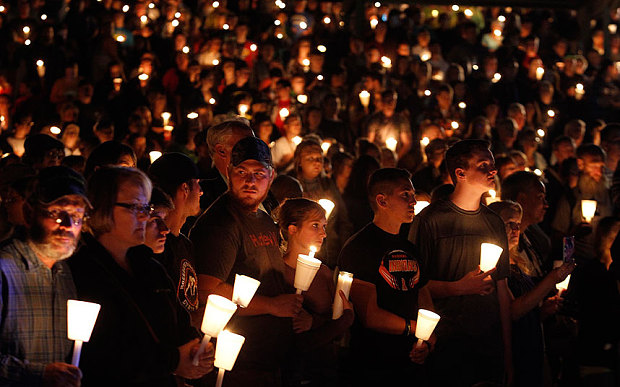
If ISIS killers showed up in Roseburg, Oregon, and executed students with impunity, maybe America would treat mass killing differently, but for now most middle Americans seem more afraid of losing their guns than losing their children. Gun apologists and lobbyists tell us to pray for the victims, but insist the solution to gun violence is more guns. More guns was the solution for the lone gunman who walked into Umpqua Community College and sprayed bullets through classrooms, killing nine and wounding twenty; he had amassed an arsenal of 13 guns.
You've heard it all before. It's the same old story, yet nothing has been done about it. Since the Sandy Hook shootings, there have been at least 986 mass shootings, with shooters killing at least 1,234 people and wounding 3,565 more. How long does it have to go on before people realize we're being held hostage by the gun lobby and gun nuts who misinterpret the U.S. Constitution? Why is it harder to get a driver's license than a high-powered rifle?
Roseburg is a small town in the state of Oregon, my home state, where plenty of people own guns for hunting. Many hunters fear the "Big Guv'mint" is going to take away their beloved guns, so they oppose any meaningful legislation that might stop future student massacres. Even the smalltown sheriff handling the case, John Hanlin, didn't understand the situation until now. According to news reports, he was one of hundreds of sheriffs around the country to vow to stand against any new gun control legislation. He even wrote a letter to the Vice President to that effect, insisting that, "Gun control is NOT the answer to preventing heinous crimes like school shootings."
So what is? The answer isn't more guns, or making it easier with any halfwit with an axe to grind to buy lethal weapons. This has reached a critical point of madness, where something must be done to make sure the nameless zeroes fuming in solitude don't get a chance to treat the rest of us like some video game fantasy.
Do we have to wait for the dumbest among us to catch up with reality, slow learners like Sheriff Hanlin, before we can enact some meaningful gun control laws? I hope not, because there are plenty of dumb people out there who believe whatever they're told by FOX News and the gun lobby. They may never come around. Without realizing it, they believe the rights of this lone gunman are more important than the rights of children, students, and families trying to live in peace, without the risk of being shot by some madman on a death trip who bought his gun easily at a gun show.
Come on, people. Get smart. Let's make it a little tougher for the bad guys.
A quote from one of my favorite books, Catch-22, comes to mind:
"The enemy," resorted Yossarian with weighted precision, "is anybody who's going to get you killed, no matter which side he's on." - Joseph Heller
Wednesday, September 30, 2015
TRANSISTOR TUNES OF SUMMERS PAST
Summer is gone and autumn is here, a time for whiskey and football and whiskey and casting our memories backward over the years and more whiskey as we approach the holidays. Long before iPods and Spotify, we listened to tiny little transistor radios, plastic junky things with tinny speakers, and we were lucky if there was one decent station in town that played music for kids--and by that I mean rock and soul and anything vaguely cool. While the other stations were playing Vic Damone and Vikki Carr we were tuning in some great music through those tinny little speakers, or even a single earplug--primitive by today's standards, for sure, but the music was good and it's all we had. Here are just a few of the tunes we savored.
The Animals, of course, covering an old blues, "The House of the Rising Sun."
Gladys Knight and the Pips, "I Heard it Through the Grapevine."
The Beatles, "I Saw Her Standing There."
And of course the incredible James Brown and his Fabulous Flames, shown here burning up the stage at the T.A.M.I. Show. Mick was waiting in the wings, learning some new steps.
The Animals, of course, covering an old blues, "The House of the Rising Sun."
Gladys Knight and the Pips, "I Heard it Through the Grapevine."
The Beatles, "I Saw Her Standing There."
And of course the incredible James Brown and his Fabulous Flames, shown here burning up the stage at the T.A.M.I. Show. Mick was waiting in the wings, learning some new steps.
Friday, September 13, 2013
AMERICA! THE GREATEST COUNTRY?
Watch out what you ask: You might get an answer you don't like.
(Warning: This contains uncomfortable truths and language most adults are familiar with in a free society.)
Tuesday, September 10, 2013
WALMART FLASH MOB
This will lift your spirits! This flash mob protest in Raleigh, NC, by Walmart workers who have the guts and audacity to believe that they should be treated fairly--and the creativity to something like this off. Some background might be helpful, in case you missed this in a news cycle of twerking and chemical warfare, but this is America at its best. September 5th was a great day as workers and their supporters rallied in 15 cities across the country to demand that Walmart pay higher wages and reinstate the 70 Walmart workers who got fired for striking this summer. Solidarity!.
Friday, July 5, 2013
WHY MAKE ART?

Who needs Art? We're in a recession, right? During tough economic times we've always slashed health care, education, environmental protection, and programs designed to help the hungry and the homeless--critical social services--so why worry about something as ephemeral as "the arts?" Surely, we can jettison a few poems and paintings in favor of more pressing concerns...right? After all, who really needs painting, music, and literature?
The novelist E. L. Doctorow gave this speech before a subcommittee of the House Appropriations Committee in the fall of 1981. It remains a timely statement on the value of art to the human spirit.

For the Artist's Sake
I have always disliked the phrase "the arts." It connotes to me furs and black ties and cocktail receptions, the patronage by the wealthy of work that is tangential to their lives, or that fills them not with dread or awe or visionary joy but with self-satisfaction.
"The arts" have nothing to do with the loneliness of writers or painters working in their rooms year after year, or with actors putting together plays in lofts, or with dancers tearing up their bodies to make spatial descriptions of the hope of beauty or transcendent myth.

So as a working writer I distinguish myself from the arts community. I am confirmed in this when I look at the National Endowment for the Arts' board and program structure. In the past, a very small percentage of the arts budget has been given over to literature, to the grants made to young writers or dramatists or poets of promise. In all the time since its founding, the N.E.A. has found only four writers worthy to sit on its immense board. Instead, the heavy emphasis has been on museums, opera companies, symphony orchestras: just those entities that happen to cater to patrons of "the arts."
I suppose I would have to confess, if asked, that I feel about opera, for instance, that it is not a living art in this country, that we do not naturally write and produce operas from ourselves as a matter of course as, for example, Italy did in the nineteenth century, and that, therefore, as wonderful and exciting as opera production may be, it is essentially the work of conservation of European culture; opera companies are conservators of the past, like museums, and their support by the National Endowment reflects this strong bias or belief in the arts as something from the past rather than the present.

The National Endowment programs I value most are just those likely to be proscribed: first, the programs of individual grants to individual artists in whatever medium — the programs endowing directly the work of living artists; and, second, those programs that do not separate the arts from life, from our own life and times but emphasize the connection — the artists-in-education program, the poets who go into schools, for example, and help children to light the spark in themselves. I cannot imagine anything more responsible than the work persuading a schoolchild to express his or her anguished or joyful observations — and to be self-rewarded with a poem or a painting. Whole lives ride on moments like that.
Or the inter-arts programs, the folk arts, the expansion arts — all bureaucratic terms for encouraging experiment and risk-taking on the part of artists, and for bringing artists in contact with people everywhere in the country, connecting people with the impulses inside themselves. Programs that encourage participation rather than the passive receipt of official art of the past are the ones I think most important: all the programs that suggest to people that they have their own voices, that they can sing and write of their own past — people in their churches, students in their classes or prisoners in their cells. These programs — just the ones branded so vilely by the Heritage Foundation Report as instruments of social policy or public therapy and slated for extinction by our new budgeteers — are the ones I value. And not from any vague idealistic sentiment either: I know as an artist where art comes from. I know there is a ground-song from which every writer lifts his voice, that literature comes out of a common chorus and that our recognition of the genius of a writer — Mark Twain, for example — cannot exclude the people he speaks for.

Art will rise where it is least expected and usually not wanted. You can't generate it with gala entertainments and $200-a-plate dinners. You can, if you're an enlightened legislative body, see to it that you don't ipso facto create an official state art by concentrating your funding on arts establishments. Other people may talk of how many billions of dollars of business is produced from the arts, but to me that is beside the point.
But saying even this, I cannot avoid the feeling that it is senseless for me to testify here today. People everywhere have been put in the position of fighting piecemeal for this or that social program while the assault against all of them proceeds across a broad front. The truth is, if you're going to take away the lunches of schoolchildren, the pensions of miners who've contracted black lung, the storefront legal services of the poor who are otherwise stunned into insensibility by the magnitude of their troubles, you might as well get rid of poets, artists and musicians. If you're planning to scrap medical care for the indigent, scholarships for students, day-care centers for the children of working mothers, transportation for the elderly and handicapped — if you're going to eliminate people's public service training jobs and then reduce their unemployment benefits after you've put them on the unemployment rolls, taking away their food stamps in the bargain, then I say the loss of a few poems and arias cannot matter. If you're going to close down the mental therapy centers for the veterans of Vietnam, what does it matter if the theaters go dark or our libraries close their doors?

And so in my testimony for this small social program I am aware of the larger picture and, really, it stuns me. What I see in this picture is a kind of sovietizing of American life, guns before butter, the plating of this nation with armaments, the sacrifice of everything in our search for ultimate security. We shall become an immense armory. But inside the armory there will be nothing, not a people but an emptiness; we shall be an armory around nothingness, and our true strength and security and envy of the world — the passion and independent striving of a busy working and dreaming population committed to fair play and the struggle for some sort of real justice and community — will be no more. If this happens, maybe in the vast repository of bombs, deep in the subterranean chambers of our missile fields, someone in that cavernous silence will remember a poem and recite it. Maybe some young soldier will hum a tune, maybe another will be able to speak the language well enough to tell a story, maybe two people will get up and dance to the rhythm of the doomsday clock ticking us all to extinction.
--E. L. Doctorow
"For the Artist's Sake." E. L. Doctorow: Essays and Conversations. Ed. Richard Trenner. Princeton, NJ: Ontario Review P, 1983: 13-15.

Saturday, June 1, 2013
SO LONG, HARVEY KORMAN
So long, Harvey Herschel Korman. Here the great comic actor visits the dentist, played by the legendary Tim Conway. This is one of the funniest comedy sketches in human history.
Sunday, May 5, 2013
SOMETHING IN THE AIR
Looking forward to "Something in the Air," a film about the events of May '68 in Paris by French filmmaker Oliver Assayas. I read an interview with Assayas in Cineaste, and he sounds fluent in the history of the time and isn’t just using the period as a cool backdrop to an otherwise formulaic story. I'm sure such a foreign, political film will vanish quickly from the art house theater (and never set foot in the Megaplexes) so I'll have a bag packed and be ready to pounce when it shows up.
The following is from Richard Porton's preview in Cineaste, and describes a scene within the film about film, a meta moment that raises questions about revolutionary art: "A spectator wonders why revolutionary films need to be made in the style of the bourgeoisie and insists that 'revolutionary films call for revolutionary syntax.' A member of the film collective responds that 'revolutionary films have to be made with a syntax understood by the proletariat' and claims that the radical style the purportedly avant-gardist audience member is advocating is just for 'aesthetes' and the 'petit bourgeois.' This brief exchange mirrors many key twentieth-century debates involving Lukacsian realism versus Adornian modernism, Costa-Gavras versus Godard and Cahiers du cinéma, as well as ongoing tensions between experimentalists and populists, who view the avant-garde as hermetic and champion the virtues of “accessibility.”
Well, it ain't Iron Man III, that’s for sure--though there's nothing's wrong with that film (I'm looking forward to it, in fact) though I don’t expect any big box office battle between the two. Summer’s here and the time is right for comic book movies, after all. (Actually, a combination of the two films might be interesting: if only the students and workers in the French film had Iron Man suits... Note to self: write that screenplay).
Saturday, May 4, 2013
MAY 4, 1970: KENT STATE MASSACRE
 May 4, 1970. The
battle lasted 13 seconds at Kent State, when Ohio National Guardsmen
opened fire on unarmed students, wounding nine and killing four. The photographs shocked a nation. A few days before, on April 30, with the help
of Henry Kissinger, his national security adviser, Nixon had broken his campaign
promise and widened the Vietnam war, concealing plans to invade Cambodia from
Congress and from Secretary of State William Rogers and Secretary of Defense
Melvin Laird—not to mention the American people. When campuses erupted in anger, Nixon said
four days after Kent State: ''I have not been surprised by the intensity of the
protests.'' He went on to add that Kent
State ''should remind us all once again that when dissent turns to violence, it
invites tragedy.'' Blaming the victim was Nixon’s stock in trade. He implied the students shot had been
violent, throwing rocks at the Guardsmen, and that they were asking for it. Months
later, the FBI report confirmed what we had suspected: that the students had
posed no threat to the Guard: ''Jeff Miller's body was found 85-90 yards from
the Guard. Allison Krause fell about 100 yards away. William Schroeder and
Sandy Scheuer were approximately 130 yards away from the Guard when they were
shot.... Sandy Scheuer, as best we can determine, was on her way to a speech
therapy class. We do not know whether Schroeder participated in any way in the
confrontations that day.'' Quotations courtesy of Martin F. Nolan.
May 4, 1970. The
battle lasted 13 seconds at Kent State, when Ohio National Guardsmen
opened fire on unarmed students, wounding nine and killing four. The photographs shocked a nation. A few days before, on April 30, with the help
of Henry Kissinger, his national security adviser, Nixon had broken his campaign
promise and widened the Vietnam war, concealing plans to invade Cambodia from
Congress and from Secretary of State William Rogers and Secretary of Defense
Melvin Laird—not to mention the American people. When campuses erupted in anger, Nixon said
four days after Kent State: ''I have not been surprised by the intensity of the
protests.'' He went on to add that Kent
State ''should remind us all once again that when dissent turns to violence, it
invites tragedy.'' Blaming the victim was Nixon’s stock in trade. He implied the students shot had been
violent, throwing rocks at the Guardsmen, and that they were asking for it. Months
later, the FBI report confirmed what we had suspected: that the students had
posed no threat to the Guard: ''Jeff Miller's body was found 85-90 yards from
the Guard. Allison Krause fell about 100 yards away. William Schroeder and
Sandy Scheuer were approximately 130 yards away from the Guard when they were
shot.... Sandy Scheuer, as best we can determine, was on her way to a speech
therapy class. We do not know whether Schroeder participated in any way in the
confrontations that day.'' Quotations courtesy of Martin F. Nolan. Friday, April 12, 2013
THE BEATLES DROP IN
Back in October of 1963, The Beatles had yet to play Ed Sullivan and gain worldwide fame, if not complete hysteria, launching a wave Beatlemania that encircled the planet. Even though they'd paid their dues playing the strip clubs and dives of Hamburg, here they're loveable moptops kicking up some joyous noise after they just happened to drop in for a set on a Swedish television show. This was music for the kids, an early version of the lads before they developed into deeper, more introspective songwriters and performers. This was a rave-up. Still, you could see the good cheer and lively music that would wipe out the Brylcreemed teen idols of the late fifties and early sixties, the endless string of banal performers like Fabian and Bobby Rydell and a slew of Elvis wannabes filling the void when the King joined the army--and forget about the old lounge crooners left in the dust. These four Liverpudlians cleared the deck. Before long, in a series of rapid and seemingly endless transformations, these working class boys would rule the world with an unrivaled catalog of music, and not just hits, brilliant layered studio creations combining experimental, avant garde composition with personal, poetic lyrics. At this point, however, it was just a lot of fun.
Sunday, March 24, 2013
MATT DAMON SCHOOLS LIBERTARIAN "JOURNALIST"
This is great. Some Tea-publican libertarian blogger tries to outsmart Matt Damon at a pro-teachers rally, and Matt schools her good. Matt's mother, who happens to be a teacher, should be proud.
Tuesday, March 5, 2013
TONY VISITS SEATTLE
Anthony Bourdain, snarky celebrity chef formerly of Les Halles, author of Kitchen Confidential, and host of several television food and travel shows, most recently "The Layover," just came to my town. He saw some things, missed some things, discovered the obvious and the obscure, and ate and drank his fill. Seattle is a foodie town. There are plenty of good restaurants at first glance, and others that gradually reveal themselves to those staying longer than a weekend. Maybe next time he'll dig a little deeper.
Wednesday, January 23, 2013
PYNCHON REVISITED
Here is a repost by popular request. Journey with us now to yesteryear...
a clip from a rare documentary on reclusive writer Thomas Pynchon
A screaming comes across the desk. It's happened before but there is nothing to compare to it now. The rumors circulating in weirdo literary cults are true: Pynchon is back. He has a new book. Voices echo the news and shoes clatter on cobblestones. Newsboys run, weaving through traffic, waving the extra edition, shouting, Extra! Extra! Read all about it! Publishers' Weekly confirms an August 16th release date for Inherent Vice:
"Part noir, part psychedelic romp, all Thomas Pynchon — private eye Doc Sportello comes, occasionally, out of a marijuana haze to watch the end of an era as free love slips away and paranoia creeps in with the L.A. fog."
 Oh, come on. What's the big deal? Another sad sack shut-in burning the midnight oil? Dime a dozen, you say. You don't see his books at the airport with shiny, embossed covers, so how good could he be? I've never heard him chatting with Terri Gross on Fresh Air. He's never shot the bull with Conan, with Dave, with Jay, with Jon...
 A rare shot of P, many years ago
Nope, he wouldn't do that. Pynchon writes well-regarded award-winning books nobody reads. OK, a few people read them, but mostly trainspotters and writers and drifters and edge dwellers; most civilians catch a whiff of all that sulfur and the sickening sweet smell of burning leaves and steer clear. Pynchon doesn't care. He's holed up somewhere in Tangier or Mexico City, a recluse, a shut in, a genius. This guy makes Salinger look like a social butterfly. Our old friend Amy Hungerford sheds some light on this man of mystery, but first here is the opening of Inherent Vice:
"She came along the alley and up the back steps the way she always used to. Doc hadn't seen her for over a year. Nobody had. Back then it was always sandals, bottom half a flower-print bikini, faded Country Joe & the Fish t-shirt. Tonight she was all in flatland gear, hair a lot shorter than he remembered, looking just like she swore she'd never look."
Professor Hungerford teaches The American Novel Since 1945 (ENGL 291) at Yale. She's whip smart and looking for trouble. Gotta love her. Here she places Thomas Pynchon firmly in the context of the political upheaval of the 1960s, and argues that Pynchon "is deeply invested in questions of meaning and emotional response." The Crying of Lot 49 is "a sincere call for connection, and a lament for loss, as much as it is an ironic, playful puzzle."
For more Pynchon, check this previous post.
a clip from a rare documentary on reclusive writer Thomas Pynchon
A screaming comes across the desk. It's happened before but there is nothing to compare to it now. The rumors circulating in weirdo literary cults are true: Pynchon is back. He has a new book. Voices echo the news and shoes clatter on cobblestones. Newsboys run, weaving through traffic, waving the extra edition, shouting, Extra! Extra! Read all about it! Publishers' Weekly confirms an August 16th release date for Inherent Vice:
"Part noir, part psychedelic romp, all Thomas Pynchon — private eye Doc Sportello comes, occasionally, out of a marijuana haze to watch the end of an era as free love slips away and paranoia creeps in with the L.A. fog."
 Oh, come on. What's the big deal? Another sad sack shut-in burning the midnight oil? Dime a dozen, you say. You don't see his books at the airport with shiny, embossed covers, so how good could he be? I've never heard him chatting with Terri Gross on Fresh Air. He's never shot the bull with Conan, with Dave, with Jay, with Jon...
 A rare shot of P, many years ago
Nope, he wouldn't do that. Pynchon writes well-regarded award-winning books nobody reads. OK, a few people read them, but mostly trainspotters and writers and drifters and edge dwellers; most civilians catch a whiff of all that sulfur and the sickening sweet smell of burning leaves and steer clear. Pynchon doesn't care. He's holed up somewhere in Tangier or Mexico City, a recluse, a shut in, a genius. This guy makes Salinger look like a social butterfly. Our old friend Amy Hungerford sheds some light on this man of mystery, but first here is the opening of Inherent Vice:
"She came along the alley and up the back steps the way she always used to. Doc hadn't seen her for over a year. Nobody had. Back then it was always sandals, bottom half a flower-print bikini, faded Country Joe & the Fish t-shirt. Tonight she was all in flatland gear, hair a lot shorter than he remembered, looking just like she swore she'd never look."
Professor Hungerford teaches The American Novel Since 1945 (ENGL 291) at Yale. She's whip smart and looking for trouble. Gotta love her. Here she places Thomas Pynchon firmly in the context of the political upheaval of the 1960s, and argues that Pynchon "is deeply invested in questions of meaning and emotional response." The Crying of Lot 49 is "a sincere call for connection, and a lament for loss, as much as it is an ironic, playful puzzle."
For more Pynchon, check this previous post.
Sunday, January 20, 2013
HOLD ON
This is the year's best song in a year of great music--a year that included great new records from Bob Dylan, Bruce Springsteen, Jack White, Neil Young, Frank Ocean, Fiona Apple, Japandroids, R. Kelly and Gary Clark Jr. But "Hold On," by Alabama Shakes, takes the cake.
Over a loopy, swampy vibe, Brittany Howard's rough and soulful voice soars from a whisper to a growl in a garage blues gospel soul song of hope and perseverance. When she sings "didn't think I'd make it to twenty-two years old" you believe it. She's not your typical rock diva, no piece of pop tart confection, no producer-designed telegenic product designed to shift units; Howard looks more like a checker at the Safeway (she's not the other Brittney, in other words) but who cares? She's real and she nails it. Some might dismiss this tune as retro, or lump it with some neo-soul or R&B revival, something derivative of old Stax/Volt sides, but this feels real, just listen, and in this age of sampling and auto-tune, when irony rules and pop pastiche is the watchword, we can forget what "real" sounds like. Just listen. Feel it. This is a song of hope and struggle and ultimately triumph--part of a tradition, to be sure, but entirely its own thing and something we could all use a little of, don't you think?
Sunday, December 16, 2012
MOYERS ON THE NATIONAL RIFLE ASSOCIATION
This clip is from a previous mass killing, or the one before that (there are so many; too many) but Moyers' comments still apply.
"A well regulated Militia, being necessary to the security of a free State, the right of the people to keep and bear Arms, shall not be infringed."
Yes, that's the Second Amendment. The right to form militias for the common defense is the key here. This has been argued till people are blue in the face, but it really wasn't until the Gun Control Act of 1968, and the Hatch Commission, that it became popularized as the individual, personal right to carry a gun around. What became known as the "individual rights" argument was promoted and pushed by the conservative movement and spearheaded by the NRA, and this decade its clear a conservative judiciary takes these arguments seriously. Regardless of interpretation, all would agree that when the words were written two centuries ago there weren't any automatic assault rifles. Needless to say, these rights are not immutable--they are the word of God, after all, but man--and are intended to serve us but can be looked at over historical time if need be.
Here is a valuable footnote. In 2008, an amicus was submitted to the US Supreme Court and signed by 15 eminent professors of early American history, and it concluded:
"Historians are often asked what the Founders would think about various aspects of contemporary life. Such questions can be tricky to answer. But as historians of the Revolutionary era we are confident at least of this: that the authors of the Second Amendment would be flabbergasted to learn that in endorsing the republican principle of a well-regulated militia, they were also precluding restrictions on such potentially dangerous property as firearms, which governments had always regulated when there was 'real danger of public injury from individuals.'”
Saturday, December 15, 2012
CHRISTMAS UNDERGROUND
The latest communique from the Ministry of Information makes it abundantly clear that while we have the fascists on the run, we need to stick together and fight the good fight during the Blitz.
Wednesday, December 5, 2012
DAVE BRUBECK, TAKE FIVE
Dave Brubeck (December 6, 1920 – December 5, 2012) was a piano player best known for "Take Five," a composition written by his longtime collaborator and sax player Paul Desmond. Brubeck was famous for his cool West Coast sound but could also play crazy, and he loved experimenting with unusual time signatures ("Blue Rondo à la Turk," for example, is played in 9/8). He will be missed by jazz fans everywhere.
Subscribe to:
Posts (Atom)