Thursday, July 15, 2010

BEYOND MOON & JUNE


The Graduate Center at The City University of New York recently hosted a forum entitled "BOB DYLAN: AMERICAN POET." The distinguished panel included Greil Marcus, John Corigliano and Howard Fishman. Dylan has received serious academic consideration for years (most recently in Christopher Ricks' "Dylan's Visions of Sin"), but the CUNY discussion is notable--and fascinating.

You know me. I'm an unrepentant Dylan fan. As far as I'm concerned, he's the greatest songwriter of the past century. No one comes close. There have been other great songwriters, of course, and some very clever--Cole Porter, George & Ira Gershwin, Hoagy Carmichael, Harry Warren, the hitmakers from Tin Pan Alley, Leiber and Stoller, Chuck Berry, Lennon and McCartney, Randy Newman, Brian Wilson, Elvis Costello--but it took Dylan to elevate the pop song into poetry. These academics agree. Not that we need their approval, of course. This is popular music and we can see for ourselves, or hear for ourselves.

But poetry? That's an elitist concern, like classical music, like opera, like dusty old tomes in university libraries argued over by pedantic, hair-splitting professors. Tweed jackets and elbow patches, right? Pipe smokers? Every rough fiber in their being--not to mention their tweeds--warns us we couldn't possibly understand the supernal delights of "Rime of the Ancient Mariner," say, so please leave poetry to the experts. Puff, puff. Poetry surely has nothing to do with a scruffy, rasping hillbilly with a guitar. This unwashed, unkempt outsider!

I went off with my hands in my torn coat pockets;
My overcoat was becoming ideal...
My only pair of pants had a big hole in them.
– Stargazing Tom Thumb, I sowed rhymes along my way..
rhyming among the fantastic shadows,
I plucked like the strings of a lyre the elastics
Of my tattered boots, one foot close to my heart!

That might have been written by Dylan. Surely he has more in common with Rimbaud than with fussy academics guarding the cannon against the barbarians. Rimbaud, like Dylan, was one of the barbarians. He stopped writing poetry when he was nineteen, and ended up running guns to Africa--hardly the comfy chair for him, the book-lined study, the quibbling in classrooms. Eventually, the profs catch up with the barbarians, allowing a few to enter the great halls. Rimbaud is now entombed in the canon, of course. Maybe Dylan, too, someday.

"Desolation Row" came from the 1965 album "Highway 61 Revisited," the record that included the hit song "Like a Rolling Stone." It was already his 6th album. (click play)


Ophelia, she’s ’neath the window
For her I feel so afraid
On her twenty-second birthday
She already is an old maid
To her, death is quite romantic
She wears an iron vest
Her profession’s her religion
Her sin is her lifelessness


"Blind Wille McTell" was recorded in 1983 and originally passed over for an album. It's hard to believe Dylan threw away this gem. For years it circulated as an outtake among collectors, and only when "Bob Dylan: The Bootleg Series" was officially released did most people get a chance to hear this haunting evocation of the blues singer and the Deep South. Listen:


See them big plantations burning
Hear the cracking of the whips
Smell that sweet magnolia blooming
See the ghosts of slavery ships
...

There’s a woman by the river
With some fine young handsome man
He’s dressed up like a squire
Bootlegged whiskey in his hand


Dylan wrote "Things Have Changed" for the film of Michael Chabon's novel Wonder Boys. It won an Academy Award for Best Original Song. Here, Dylan's older, looking world weary as he puffs on a cigar, the mystery man who once symbolized commitment and giving a damn, but things have changed:


A worried man with a worried mind
No one in front of me and nothing behind
There’s a woman on my lap and she’s drinking champagne
Got white skin, got assassin’s eyes
I’m looking up into the sapphire-tinted skies
I’m well dressed, waiting on the last train...

People are crazy and times are strange,
I'm locked in tight, I'm out of range,
I used to care, but things have changed.


note: Believe it or not, it's been a couple months since we posted Bob Dylan. In that time we've posted a host of other musicians, including Janis Joplin, Willie Nelson, The Fugs, Bill Frisell, Artie Shaw, Jerry Jeff Walker, Nanci Griffith, Astor Piazzolla, Howlin' Wolf, Spike Jones, Bruce Springsteen, Sly & the Family Stone, Eric Burdon, Los Lobos, Blind Faith, the Stones, Lambchop, Merle Haggard, Neko Case, Jimi Hendrix, Cat Power, Joni Mitchell and Mama Cass. We're doing our best to cover a wide range of music that you might not hear on the radio.

Wednesday, July 14, 2010

TULI KUPFERBERG SAYS GOODBYE

Tuli Kupferberg, September 28, 1923 – July 12, 2010

Okay, guys, so quit dying. Yesterday I got the news that Tuli Kupferberg, co-founder of the Fugs, passed away. Tuli and Ed Sanders formed the band in 1964, taking the name from a euphemism for "f**k" used in Norman Mailer's novel, The Naked and the Dead. The Fugs were political and social provocateurs, poets in the beat tradition, over-educated New York bums. They bridged the folk and rock scene, and were the link between the beatniks and the hippies, and were busted for obscenity on a regular basis. What would you expect in a society where even using the word "sex" was considered bad taste?

They could sing something sweet and gentle like "I Want to Know" or "Morning, Morning" like medieval troubadours ("Morning, morning, feel so lonesome in the morning...Starshine, starshine, darling kiss me as I leave") then turn into your parents' worst nightmare and sing "Johnny Pissoff Meets the Red Angel" or "Kill for Peace" or "I'm Doin' All Right." Click on play button:


I'm not ever gonna go to Vietnam
I prefer to stay right here and screw your mom
when you see me on the street you yell 'Jesus Christ!'
but I"m gettin' mine...
I'm doin' all right
!

This was not the sweet Joan Baez side of the peace movement--this was in-your-face street theater from the Lower East Side, hardcore beatniks with electric guitars who played William Blake's Songs of Innocence by starlight and in the harsh light of day taunted squares like cabbies in a traffic jam. This was The Fugs, and we loved them.

The Fugs: Ed Sanders, Tuli Kupferberg, Ken Weaver

Was this a cultural revolution or just plain old bad manners? They were shocking to some, but fans found more obscenity in the news coming out of Vietnam. Sure, they said bad words. Get over it. Airplanes were dropping napalm, Buddhists monks were burning in protest, politicians were lying. The CIA was assassinating elected officials, mining harbors, torturing prisoners and "destabilizing" governments--all in the name of American freedom. The Fugs, on the other hand, were all about freedom.

Listen to CIA Man by the Fugs:


In our upstanding community--like so many across the country--Fugs albums were contraband, communiques from the underground smuggled in under cover of night, a direct link to the Beat artists and Blake and crazy mad Greenwich Village and the anti-war parade. We huddled around primitive record players and heard phrases like "sea-green penis" and "petrified tapir snout" and "buttocks popping arpeggios of lust" and "nameless voices crying for kindness." They never made it on Hollywood Palace or Ed Sullivan, that's for sure. They never had a hit on the Top 40. Tuli and Ed Sanders were subversive scholars tossing a wrench in the works--where else would you hear something like "Swinburne Stomp" or "Auguries of Innocence" or "Ramses II is Dead, My Love," not to mention "Amphetamine Shriek" or "Kill for Peace"? Dangerous words uttered on the steps of Athens. Tuli Kupferberg was a poet warrior, a "yiddish-speaking 60’s rebel, an unrepentant anarcho-pacifist," an absolutely honest man with a sling in his hand and a tiny pebble. Rest his dangerous soul.

The final word from Tuli Kupferberg:

Tuli Kupferberg THERE ARE ONLY THREE JOKES from Thelma Blitz on Vimeo.

Tuesday, July 13, 2010

HARVEY PEKAR, RIP

Harvey Pekar, 1939-2010

Harvey Pekar chronicled his life in an autobiographical comic book series "American Splendor," portraying himself as a obsessive-compulsive curmudgeon at war with loneliness and depression. Pekar was difficult--not one for cocktail party chit chat--and he might have remained a cranky, unknown file clerk had it not been for a fortuitous friendship with cartoonist Robert Crumb. He first met Crumb in 1962 at the American Greetings in Cleveland, and the artist illustrated Pekar's first autobiographical comic in 1972.

Pekar continued collaborating with cartoonists. He wrote and they drew. According to Wikipedia, "Pekar's most well-known and longest-running collaborators include Crumb, Gary Dumm, Greg Budgett, Spain Rodriguez, Joe Zabel, Gerry Shamray, Frank Stack, Mark Zingarelli, and Joe Sacco; while recent years have seen him repeatedly team up with artists like Dean Haspiel and Josh Neufeld. Other notable cartoonists who have worked with Pekar include Jim Woodring, Chester Brown, Alison Bechdel, Gilbert Hernandez, Eddie Campbell, David Collier, Drew Friedman, Ho Che Anderson, Rick Geary, Ed Piskor, Hunt Emerson, Bob Fingerman, and Alex Wald."

Pekar and Paul Giamatti

From there he earned underground fame and flirted with mainstream attention from some cranky bouts with David Letterman and the film of his story,"American Splendor," starring Paul Giamatti as Pekar.

Harvey was found dead at 1 am by his wife, Joyce Babner, in their Cleveland home. Cause of death is yet to be determined. He'd fought cancer for years (first diagnosed with lymphatic cancer in 1990, resulting in a comic called "Our Cancer Year"). "He was recently diagnosed with prostate cancer," says the Cleveland Plain Dealer, "and also suffered high blood pressure, asthma and clinical depression, which fueled his art but often made his life painful."

In 1989, the New York Times Book Review said, "Mr. Pekar's work has been compared by literary critics to Chekhov's and Dostoevski's, and it's easy to see why."

Sunday, July 11, 2010

JANIS JOPLIN COMES HOME


Janis Joplin was a wild woman with a big heart and a big voice. In the parlance of the day, she let her freak flag fly. Larger than life, like a cross between Annie Oakley and Bessie Smith, she sang as if her life depended on it. Maybe it did. She acted tough, like she didn't care what anyone thought, but you can tell she sings the blues from experience. Back then, she was a crazy hippie freak and the squares didn't know what to make of her. Even Dick Cavett, probably the most intellectual of the talk show hosts, boasting a Yale education and liberal politics, has a hard time with Janis. She comes out like gangbusters in boots and scarves and feather boas, the last of the red hot mamas, and Cavett mistakenly thinks he can play her for laughs. She wins him over, as she wins us, with genuine warmth. And when she sings, forget about it it. You'd better feel it or you're a couple quarts low on soul. No doubt some slick producers might have thought, Well, this chick has talent if she only reigned it in a little, smoothed out her rough edges and acted a little more ladylike--but that would be missing the point. She was rough as a catfight in a barrelhouse and sweet as Tupelo honey. She could break your heart while she called you on your dirty lowdown ways.

Nowadays, in this age of rehab and self-help, folks will remember Janis as a sixties icons who died--like so many of them--from her excesses, her addictions, more of a cautionary tale than real person, but that's simplifying Janis, and she was anything but simple. She was real, all right--so real she demanded you become real, too, and meet her halfway, at least, in that place beyond Hollywood plastic and pop entertainment with its cookie cutter sentiment. That's too much to ask of some people. When she talks about returning to her hometown for her high school reunion she's not just making clever chit chat for a talk show. It's an amazing moment. Watching these clips make me miss Janis and what she brought to the party--if she were here she'd probably laugh and say don't get so serious, honey, have a swig of Southern Comfort and let's get this party started.

Saturday, July 10, 2010

BILL FRISELL, GUITAR PLAYER


Bill Frisell is an amazing musician--a guitar player who combines jazz, rock, folk, country, oldtime Americana and otherworldly space music and makes it his own. I've seen him play an entire evening of Thelonious Monk, or trade jazzy licks with another guitar gunslinger, or draw from the great American songbook and play "Shenandoah" and "A Change is Gonna Come." He's also a crack session guitarist, and undoubtedly you've heard him play on records by others without even knowing it, with everyone from John Zorn to Elvis Costello, Lucinda Williams to Steve Earle, Ron Carter to Bono. His own albums are amazing journeys. My favorites are "Good Dog, Happy Man," "The Willies," "Have a Little Faith," and "History, Mystery," a double album with tracks originally written for Mysterio Sympatico, a multi-media collaboration with artist Jim Woodring that premiered at St. Ann's Warehouse in Brooklyn in 2002.

Bill Frisell runs with the big dogs but stays cool

Bill Frisell can play anything. Maybe that's why he's won Grammy Awards and topped the prestigious DownBeat Magazine's critic poll for best jazz album of the year and best guitar player of the year, several times. You'd think this would all go to his head, but I've had the pleasure of meeting Bill a few times and he's always been thoughtful and soft-spoken, with an easy smile and a gentle sense of humor--eons from the arrogance one might expect from a world class musician. He may be a musical genius, sure, but he's not about to throw the television out the hotel window. He's a guitar player inspired by music, all kinds. Go buy his albums.


"Sugar Baby" by Bill Frisell, with special guest Djelimady Tounkara,
and Greg Leisz, Jenny Scheinman, Sidiki Camara~Feb 29, 2004

Friday, July 9, 2010

HORUS THE EGYPTIAN SUN GOD

We're in the middle of a hot spell, so someone must be praying to Horus, the Egyptian God of the Sun. Horus is one of the oldest deities in the Ancient Egyptian religion, and often depicted as a falcon, or a man with a falcon's head. Worshipped from the Dynastic Period through Greco-Roman times, Horus is also known as the Lord of the Sky.

A few years ago I painted a spoof of the old calendar art of dogs playing poker with gods playing poker and included Horus on the top left. You probably recognize some of the others. By the way, if you stumble upon a high stakes poker game like this I'd advise you not to buy in. (More of my artwork can be found at Bob Rini Makes Art)

"High Stakes"

Thursday, July 8, 2010

DESPERADOES


Down in Texas there's a war--always has been--between shitkickers and hippies. The kickers are cowboys who wear cowboy hats and boots and Texas longhorn belt buckles and love George Bush and hate the damn hippies. As Jerry Jeff Walker put it in his song "Up Against the Wall, Redneck Mother," the typical kicker chases down his Falstaff beer with Wild Turkey, and drives a fifty-seven GMC pickup truck with a gun rack and a bumper sticker that reads "Goat ropers need love, too." Speaking of love, kickers love nothing more than "kicking hippies asses and raisin' hell."

Marlboro Man, shitkicker

Texas hippies, on the other hand, tend to wear their hair long and smoke loco weed now and then, or at least drink some good Shiner Bock beer. They are fiercely independent and take after the outlaws of the Wild West. They might wear cowboy hats and boots, but they're decidedly outlaw about it. Willie Nelson is the classic example. Or Townes Van Zandt. Or the folks in the video up top.

Townes Van Zandt, hippie

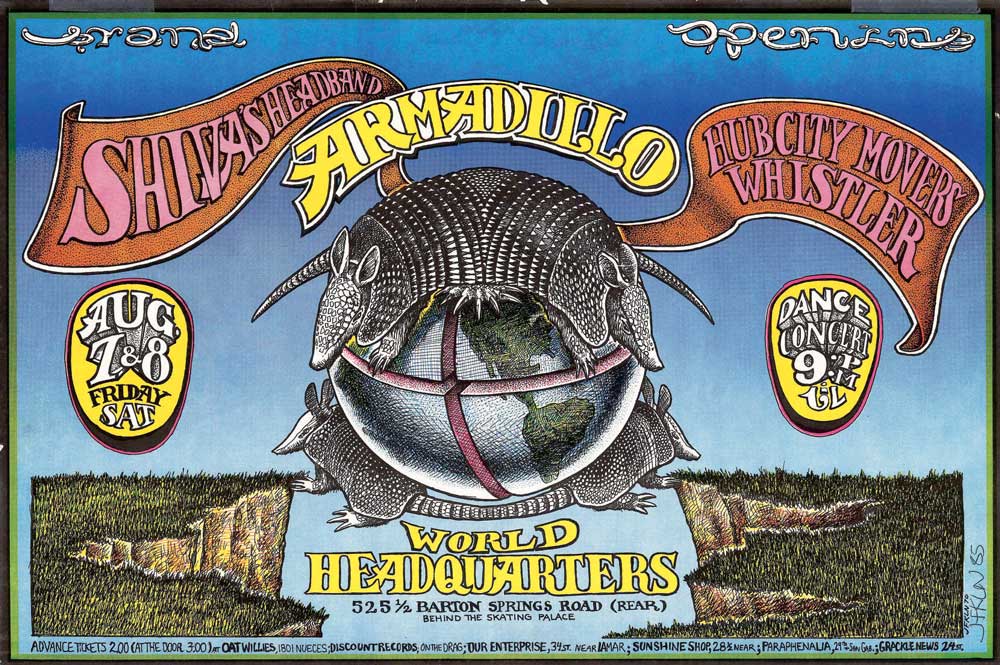
While the Texas longhorn is the symbol of all things kicker, the mascot of the Texas hippies is the armadillo, a tough little creature that knows when to roll into a ball. Armadillos were popularized for the alternate Texas scene by cartoonist Jim Franklin back in the sixties, and in 1970 the Armadillo World Headquarters opened in Austin for rock shows and other subversive hippie activities. It's been a long strange trip but those ornery little buggers are still hanging on.


In Texas, both the kickers and the hippies love country music, barbecue, Mexican food, and--surprisingly enough--Willie Nelson (who doesn't?). Willie is a dyed-in-the-wool Texas hippie and patron saint of Austin, Texas. God bless Willie.

Willie Nelson, damn hippie

Of course, we're speaking in gross generalities--no one is truly and completely a cultural stereotype, after all, but you'd be surprised how many folks fit somewhere on this spectrum. And there are other mutations in Texas, too, such as cowpunks and rockabillies, Texas Swingers, Texas Two-steppers, rodeo clowns and a huge population of Hispanics and Native Americans who were there before white folks showed up. Still, for the sake of our overly simple dichotomy, play along with me...okay? Now let's listen to some music.

Top clip: Nanci Griffith joined by the best of the Texas singers and songwriters, Guy Clark, Jerry Jeff Walker, Steve Earle, Rodney Crowell, Eric Taylor and Jimmie Dale Gilmore. They sing a classic country song written by Guy Clark, "Desperadoes Waiting for a Train." The song is guaranteed to melt the toughest kicker heart.


Willie and friends, including Kris Kristofferson, singing "Ain't it Funny How Time Slips Away."